
OpenStatus
Open-source uptime monitoring with built-in status pages
An open-source platform that combines uptime and API monitoring with status pages, incident updates, and monitoring-as-code workflows. It can be used as a managed service or self-hosted, though self-hosting currently depends on private probe locations.
In depth
What it is
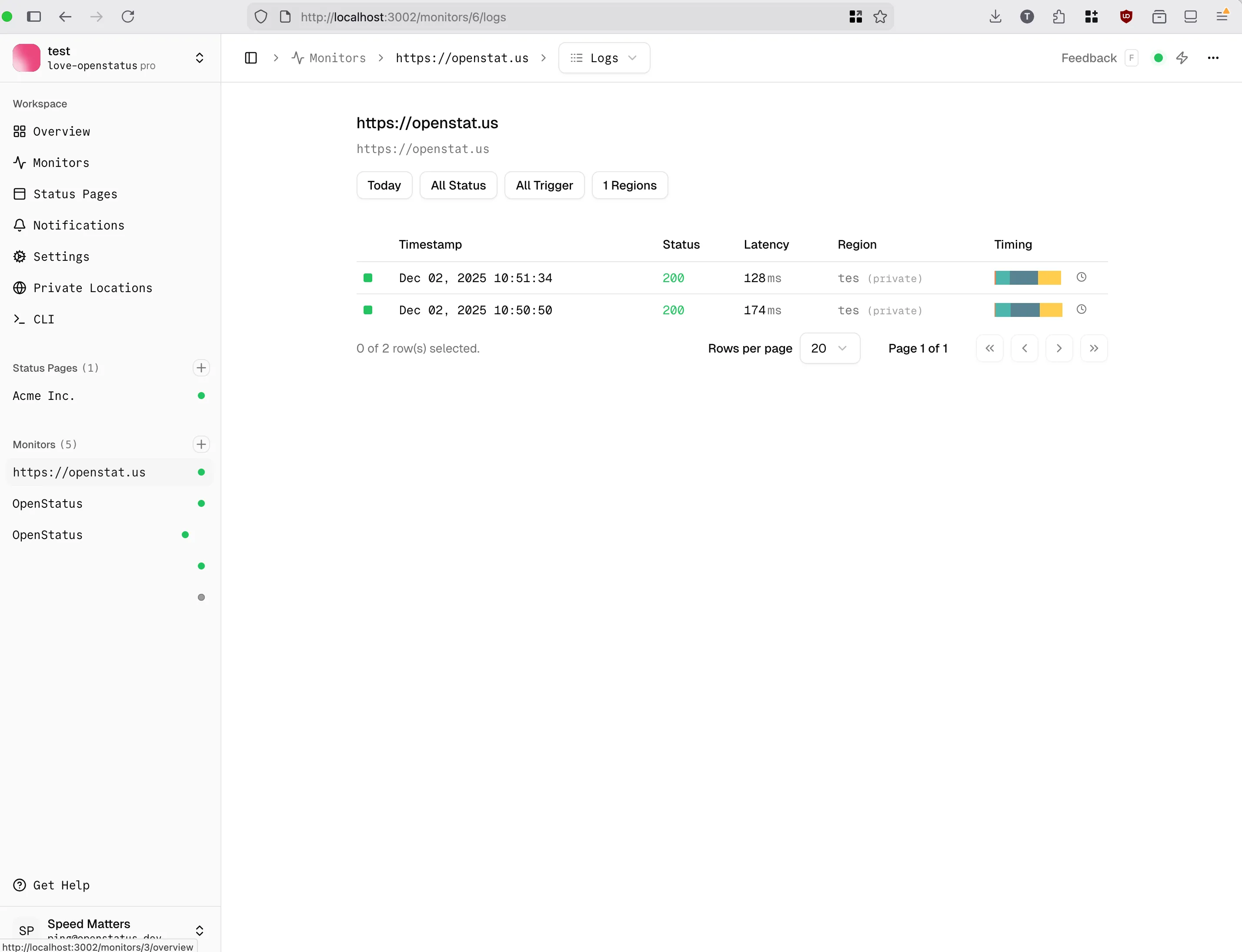
OpenStatus is an open-source uptime monitoring and status page platform for checking websites, APIs, DNS, and TCP endpoints from external locations. It combines synthetic monitoring, incident communication, and monitoring-as-code workflows in one product, with both hosted and self-hosted deployment options.
Key features
- Synthetic monitoring - HTTP, TCP, and DNS checks with assertions, thresholds, and response validation.
- Status pages - Public or restricted status pages with incidents, maintenance windows, and subscriber updates.
- Monitoring as code - YAML configuration, CLI, Terraform support, and GitHub Action workflows.
- Interoperability - OTLP export plus private-location probes for internal or controlled environments.
Strengths
- Unified workflow - Monitoring and user-facing status communication live in the same tool.
- Deployment choice - Available as a managed service or self-hosted open-source software.
- External coverage - Designed for internet-facing uptime checks, with private probes for internal services.
Trade-offs
- Limited scope - Focused on uptime and status communication rather than full logs, traces, and APM depth.
- Self-hosting complexity - Self-hosted deployments involve multiple services and currently rely on private locations for checks.
- Smaller enterprise layer - Governance and integration breadth are lighter than in larger observability suites.
Pricing
Open-source software under the AGPL-3.0 license, with self-hosting available. The managed service has free and paid SaaS tiers, while self-hosted cost is mostly infrastructure and operations.


